Workplace Exposure Limits Eh40/2005 Fourth Edition 2020
The Guidance note EH40/2005, entitled Workplace Exposure Limits, is a document published by the Health and Safety Executive which gives legally binding workplace exposure limits for substances hazardous to health.
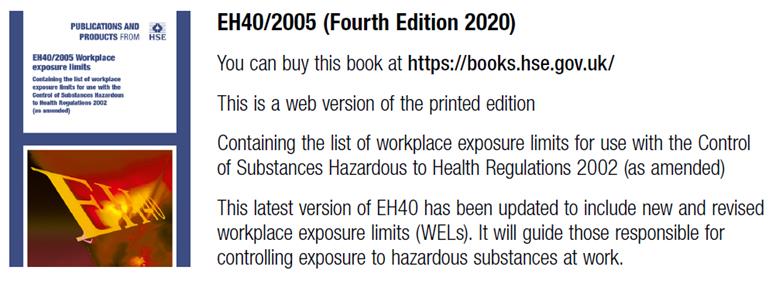
The latest edition of EH40 continues with the setting of, and compliance with, Occupational Exposure Limits (OELs). The previous system, setting OELs as Maximum Exposure Limits (MELs) and Occupational Exposure Standards (OESs) has been discontinued in favor of a single type of OEL known as the Workplace Exposure Limit (WEL). This new system was introduced on 6 April
NOTE:
- MEL/OES values were quantified in ppm (parts per million)
- WEL’s are quantified in either ppm (as above) or mg/m-3
WELs are Occupational Exposure Limits (OELs) set under COSHH, in order to help protect the health of workers. WELs are concentrations of hazardous substances in the air, averaged over a specified period of time referred to as a Time-Weighted Average (TWA). Two time periods are used: long term, 8hrs (Long Term Exposure Limits - LTEL’s) and short term, 15 minutes (Short- Term Exposure Limits - STELs). STELs are set to help prevent effects, such as eye irritation, which may occur following exposure for a few minutes.
The changes came about as a result of concerns expressed by HSC’s Advisory Committee on Toxic Substances (ACTS) about how well employers and other stakeholders understood OELs, and about how widely these were being used in industry.
Research carried out for HSE showed that those concerns were justified. As a result, an ACTS Working Group was given the task of considering a new approach to the setting and use of OELs.
EH40/2005 Contents: Foreword; Introduction; List of workplace exposure limits (WELs); Tables 1: List of approved workplace exposure limits; Supplementary information for table 1; Applying occupational exposure limits; Calculation methods; Monitoring exposure; Mixed exposures; Table 2: Biological Monitoring Guidance Values (BMGV’s); List of synonyms; References, further information.